Discover courses, digital products, coaching, and more from talented creators
173 results found
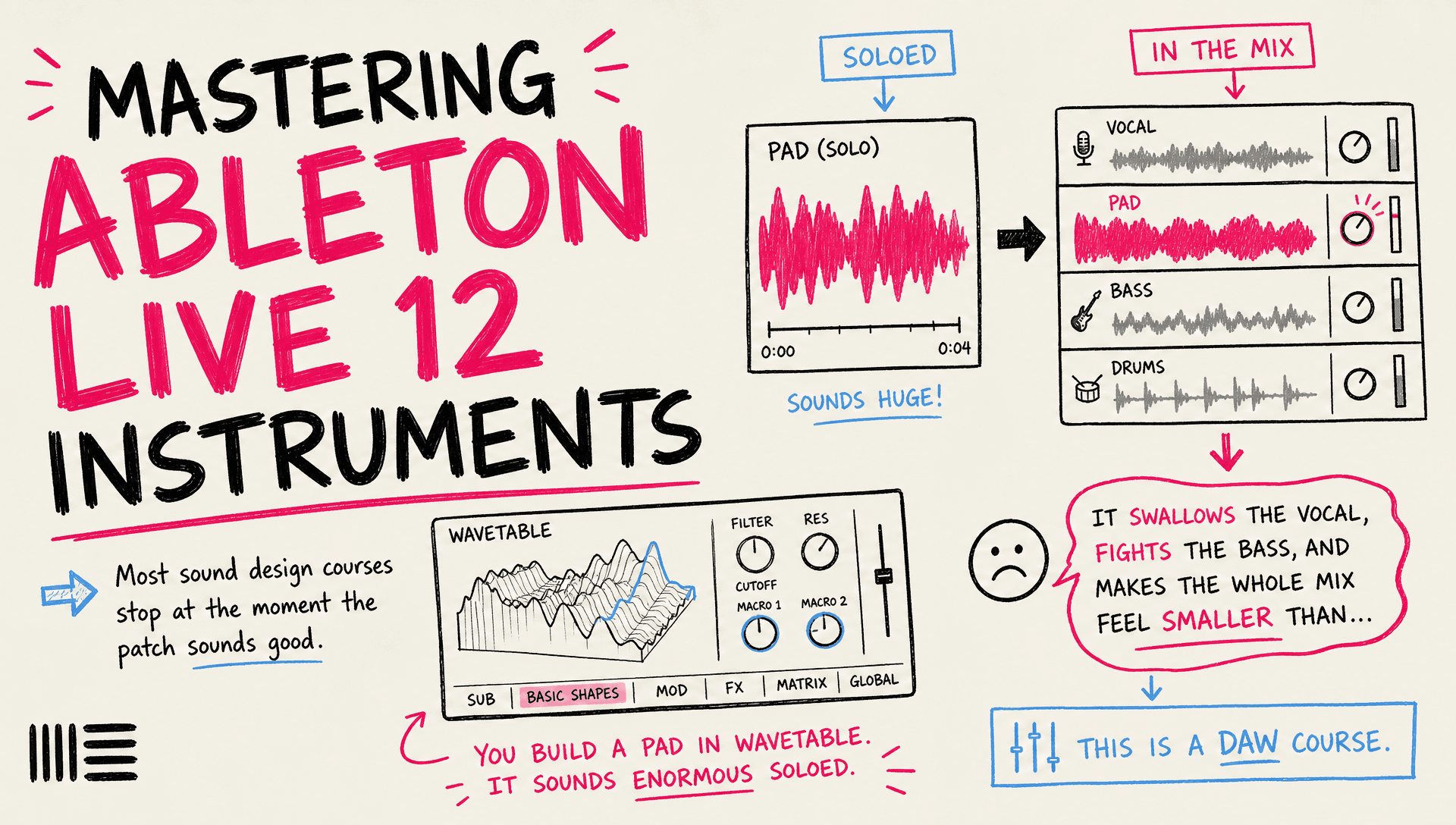
Most sound design courses stop at the moment the patch sounds good. You build a pad in Wavetable. It sounds enormous soloed. You drop it into the project and it swallows the vocal, fights the bass, and makes the whole mix feel smaller than it did before you added it. That gap — between a patch that sounds good and a patch that works — is where most producers get stuck. It isn't a sound design problem and it isn't a mixing problem. It's the space between them, and almost nobody teaches it. This course does. What it covers Every instrument in Ableton Live 12. Not the popular four — all of them. Synthesis Drift and Analog for subtractive. Wavetable for wavetable synthesis and custom tables. Meld for bi-timbral macro oscillator design and MPE. Operator for FM, additive and hybrid approaches. Physical modeling Collision, Tension and Electric — the mallet, string and electric piano models, including what they do well and where sampling still wins. Sampling Simpler for fast work, Sampler for multi-sampled instruments you build yourself, and the workflow for getting from a raw recording to a playable, expressive instrument. Drums Drum Rack, Impulse and Drum Sampler, compared directly by building the same kit three ways. Granular and Max for Live Granulator III, the eight DS drum synths, and the CV instruments for driving modular hardware. Systems Instrument Racks for layering, splitting, and building hybrid instruments that don't exist in Live until you make them. The course is organised by synthesis method, not alphabetically. You learn what an envelope, a filter and a modulation matrix actually do once — then meet them again in eight different instruments. That transfers. Device-by-device courses don't. The part that's different Every instrument module ends with a Mixing Context chapter. Not general mixing theory. Specific, per-instrument answers: why FM patches read as harsh and what to do about it. Why Wavetable's position modulation causes problems in a busy mix that Analog's doesn't. How to decide whether Wavetable's sub or your bass track owns the low end. Where Electric's pickup control replaces an EQ move. How Drift's Unison width eats a stereo field. This comes out of the mixing frameworks taught across the rest of the [PausePlayRepeat] catalogue — the three-zone approach, the 3 dB rule, subtractive-first thinking — applied at the instrument rather than after it. Design the sound so it fits. Then you barely have to fix it. You'll finish able to Choose the right instrument for a sound in seconds instead of auditioning five Build a patch from silence without reaching for a preset Read any synthesizer's interface — in Live or outside it — because you understand the architecture underneath Design a sound that already sits in the mix, rather than fighting it afterwards Build custom hybrid instruments in Instrument Racks and map them for performance Know which of Live's instruments to stop trying to force into jobs they're bad at Who it's for Producers who own Live and use maybe four of its instruments. Anyone who has watched a synth tutorial, followed along, got the sound, and still couldn't build a different one afterwards. Sound designers coming from other DAWs who need Live's specific implementations. Anyone whose patches sound great alone and disappear in a mix. Who it isn't for If you're looking for preset packs, genre templates, or a "make a track in 20 minutes" course, this isn't that. This is architecture. It's slower up front and considerably faster forever after. What you need Ableton Live 12 — see the edition note below. No prior synthesis knowledge. If you know what a filter does, you'll be comfortable; if you don't, Module 1 covers it before anything else starts.
If you like the clips we post on our social media and don't want to mess with accounts, here's a tip jar where you can donate to us!
In this Course, you will learn the basics about Gain Staging and Cleaning, Eqing, Compressing and Shaping the dynamics of your audio tracks. Hello, my Name is Nils aka 66 Up. I'm a 21 year old mixing engineer and artist since 2018. We are going to work on every detail of your skill set to improve your Mix to give your songs the special touch that they're missing.
Fundamentals of production and answering your questions.
Need an original track for your project? You're in the right place. Genres of Specialization: - Game Music - Rock - Hip Hop - Classical - Jazz - Funk *Please be as specific as possible about your vision and provide reference tracks.* *For bigger orders (more than 3 tracks) contact me directly.*


PPR Heavy-weight
A complete, systems-based course on automation as a mixing, sound-design, arrangement, and performance tool. Master the fourth dimension of your mix: rides, fades, pans, mutes, send throws, filter sweeps, builds, drops, transitions, modulation, and a fast professional workflow, across any DAW.
A complete, systems-based course on the noise gate and downward expander as both cleanup and creative tools. Master threshold, range, attack, hold, release, hysteresis, and the key input so you can tighten drums, clean vocals, build trance gates, recreate the 80s gated-reverb snare, and design with gates on any plugin.
A complete, systems-based course on delay as a creative and mixing tool. Master time, feedback, filtering, modulation, stereo, and routing so you can dial in any delay sound on any device, for groove, depth, width, texture, and full sound design.
Delay Selection and Integration: A Diagnostic Framework
Unlock the secrets to building a loyal fanbase with 'The 5 Levels of Fan Development (Unaware → Superfan).' This comprehensive cheat-sheet is designed for music producers and beatmakers who want to elevate their connection with listeners and turn casual listeners into devoted fans. Inside, you’ll find actionable insights and strategies tailored to each level of fan development, from the initial awareness phase to transforming your audience into superfans who amplify your music. With high-quality visuals and professional production value, this cheat-sheet is not only a practical guide but also an inspiring tool to help you create better music through deeper engagement. Perfect for independent artists, record labels, and anyone looking to enhance their marketing strategies, this resource will empower you to navigate the complexities of fan relationships while focusing on what you do best—making amazing music. Whether you're just starting out or looking to refine your approach, this cheat-sheet will provide the roadmap you need to cultivate a passionate community around your sound.
Delay Selection and Integration: A Diagnostic Framework
Convolution Reverb: Capturing Real Acoustic Spaces
Music Theory for DAW-Based Music Producers • Foundations - Understanding Musical Building Blocks
Unlock the secrets of sound with our comprehensive cheat-sheet, "Overdrive vs Distortion vs Fuzz — Full Comparison." This essential guide breaks down the nuances of three classic distortion circuits, equipping producers with the knowledge to elevate their music production. Dive deep into the sonic characteristics, use cases, and the subtle differences between overdrive, distortion, and fuzz, empowering you to make informed decisions in your sound design. Perfect for both novice beatmakers and seasoned producers, this resource provides high-quality visuals and clear, concise explanations that demystify these effects. Whether you’re looking to add warmth to your tracks with overdrive, achieve that biting edge with distortion, or unleash a wild, psychedelic vibe with fuzz, this cheat-sheet will serve as your go-to reference. Enhance your understanding of these pivotal effects and transform your sound with confidence. With professional production value and an easy-to-navigate format, you’ll have the tools you need to create music that stands out. Don’t just produce—produce with purpose and precision. Get ready to redefine your soundscape today!
The Frequency Spectrum, Actually Mapped
Every stock audio effect in Ableton Live 12.Every stock audio effect in Ableton Live 12.4, taught with the depth professionals actually need. 58 chapters across 11 modules cover EQ, dynamics, saturation, delay, reverb, modulation, pitch, lo-fi destruction, utility, and mastering — with parameter ranges, decision frameworks, and hands-on exercises for every device. Updated for Live 12.4 (new Erosion, Auto Pan-Tremolo, Auto Shift, Delay).